


Capabilities

Nine disciplines. One engineering team.

From the site survey to the maintenance schedule, the same team owns scope, sizing, installation, commissioning and ongoing operation. Below is what we deliver — in depth.

Index
  1. 01

    IP Video & AI CCTV

    Network cameras, VMS, edge inference and analytics rule sets.

  2. 02

    Smart City

    Urban CCTV, traffic, environmental sensing, public-realm lighting and command-centre integration.

  3. 03

    Enterprise Network & Wi-Fi

    Switching, routing, structured cabling, SD-WAN and wireless design.

  4. 04

    Network & Server Security

    NGFW, IDS/IPS, NAC, segmentation, server hardening and endpoint protection.

  5. 05

    Virtualization & Server Infrastructure

    VMware, Hyper-V, KVM platforms with VDI, HCI, backup and DR.

  6. 06

    Cloud & Hybrid

    AWS landing zones, migration, hybrid architecture, observability.

  7. 07

    IoT & LoRaWAN

    Long-range sensor networks, gateway-to-dashboard pipelines.

  8. 08

    Intelligent Traffic Systems

    Vehicle detection, classification, incident analytics for corridors.

  9. 09

    Smart Lighting Control

    Networked lighting and sensor control for campus and public deployments.

§ 01 / 09

01 — IP Video & AI CCTV

Network video, engineered for the site it serves.

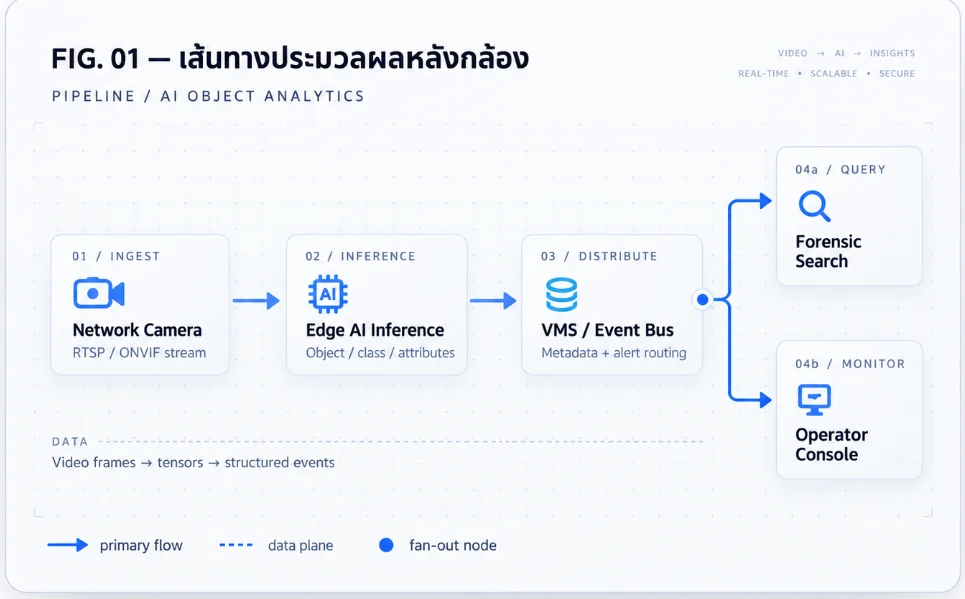
A surveillance system is only as good as its weakest link — placement, lens, lighting, network path, storage profile. We design every component for the operational requirement and run analytics on-device or at the server tier as appropriate.

  • Camera selection & placementSensor sizing, lens choice, lighting tolerance and field-of-view modelled per location.
  • VMS & storage architectureRecording strategy, retention, redundancy and bandwidth sized to the deployment.
  • Open integrationONVIF, RTSP and event APIs into VMS, access control and operations platforms.
People countingFootfall, occupancy, dwell.
ANPR / LPRLicense-plate recognition.
Queue analyticsLength, wait, service rate.
LoiteringZone & dwell rules.
IntrusionLine-crossing, restricted zone.
PPE complianceHelmet, vest, mask detection.
TailgatingEntry-point misuse detection.
Crowd flowDensity & direction analytics.
Forensic searchAttribute-based recall.
Fig. 01 — AI CCTV pipeline
§ 02 / 09

02 — Smart City

Urban systems that produce operational data.

Cities and authorities increasingly run on the same instrumentation: cameras, sensors, traffic detection, environmental monitoring and networked lighting feeding command-centre platforms. We design integrated deployments rather than disconnected point-solutions.

Urban CCTVMulti-site network video and VMS.
ANPR corridorsVehicle access and movement logging.
Traffic analyticsCounts, classes, incidents, dashboards.
Env. sensingAir quality, noise, water level.
Public lightingSchedule, dimming, fault telemetry.
Command centreUnified operator dashboards.
Fig. 02 — Smart city skyline & sensor network
§ 03 / 09

03 — Enterprise Network & Wi-Fi

The backbone everything else runs on.

Cameras, sensors, servers and cloud workloads only work if the network does. We design and deliver the infrastructure layer with engineering discipline equal to the systems above it.

Switching & routing

Core, distribution and access layers sized for the traffic profile, with VLAN, QoS and PoE budgets matched to the load. Dynamic routing where it earns its keep.
Wireless

Indoor and outdoor Wi-Fi with coverage and capacity modelled, not estimated. Site surveys, controller-based or cloud-managed designs.

SD-WAN & multi-site

Multi-link, multi-site networks with policy-driven path selection, encryption and segmentation between branches and data centres.

Structured cabling

Pathways, terminations, labelling and as-built documentation to a standard the next engineer can read.

Segmentation

VLANs, VRFs and policy that separate surveillance, IoT, corporate and guest flows — the foundation for security and reliability.

Monitoring

SNMP, syslog and flow-based visibility into the device health and traffic of the network you're operating.

§ 04 / 09

04 — Network & Server Security

Defence sized to the threat model.

Perimeter is necessary but not sufficient. We design layered defences that include east-west controls, server hardening and endpoint posture.

Next-gen firewall

NGFW policy, application awareness, deep inspection, web filtering, logging and SIEM integration.

IDS / IPS

Signature and anomaly detection placed at the boundaries that matter, with tuning rather than default rule sets.

NAC & 802.1X

Identity-based access, posture assessment and dynamic VLAN assignment — especially for IoT and surveillance estates.

Server hardening

Baselines, patching schedules, configuration management and credential hygiene for Windows and Linux estates.

Endpoint protection

Modern EDR/AV stack, application control, disk encryption and centralised reporting.

Segmentation & zero-trust

Micro-segmentation between workload tiers, OT/IT separation, and policy that follows identity rather than IP.

§ 05 / 09

05 — Virtualization & Server Infrastructure

Compute that consolidates without compromising.

Virtualization done well reduces footprint, improves resilience and gives operations a foundation to automate against. We design platforms that are sized for workload growth and built around an explicit backup and disaster-recovery strategy.

  • Hypervisor platformsVMware vSphere/vCenter, Microsoft Hyper-V, Proxmox/KVM — selection driven by workload and operational fit.
  • HCI & storageHyper-converged or traditional SAN/NAS designs with replication and snapshot strategy.
  • VDI & remote accessVirtual desktop platforms for distributed and contracted workforces.
  • Backup & DRRPO/RTO-driven design with offsite and offline restore paths.
Fig. 04 — Virtualization stack
§ 06 / 09

06 — Cloud & Hybrid

Cloud architectures designed to be operated, not just provisioned.

Cloud workloads age differently to on-premise ones. We design landing zones and migration paths with cost predictability, access governance and observability built in from day one.

AWS landing zones

VPC, account, IAM and SCP design with guardrails. Logging, billing and security configured before workloads land.

Migration & lift-shift

Application, VM, database and storage migrations with a cutover plan that preserves operational continuity.

Hybrid & connectivity

Direct Connect / VPN with route, MTU and BGP design that doesn't fall over the first time a path fails.

Observability

Logs, metrics, traces, alerting and cost dashboards — designed for the team that will operate the platform.

Cloud security

Identity-first design, secrets management, KMS, posture monitoring and tested incident-response runbooks.

FinOps

Tagging, budgets, reserved-instance / savings-plan strategy and right-sizing as a continuous practice.

§ 07 / 09

07 — IoT & LoRaWAN

Sensor networks that span sites.

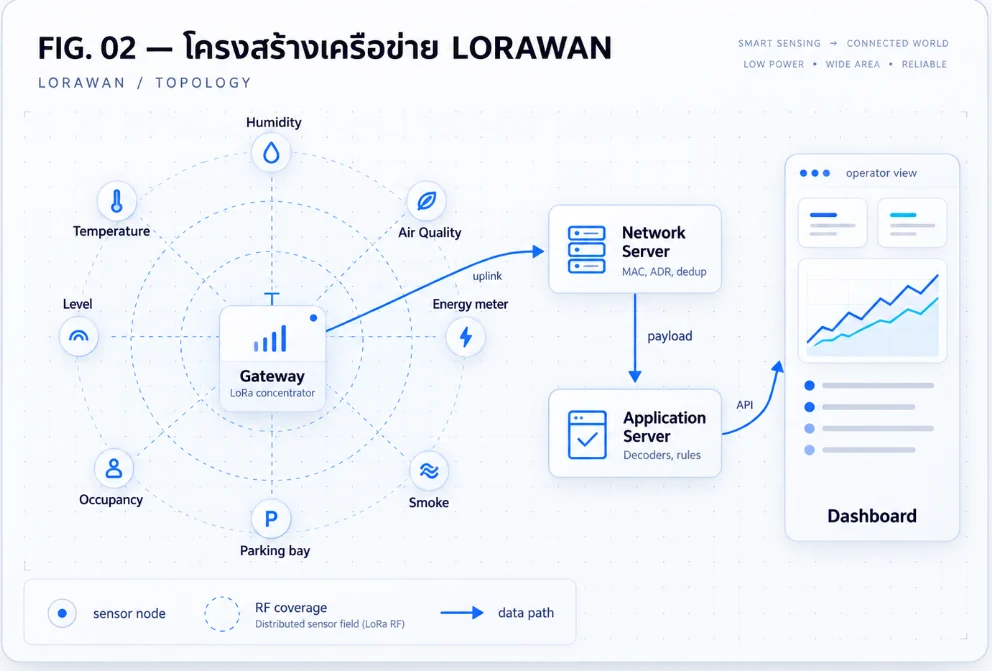
LoRaWAN delivers kilometres of range and multi-year battery life on a sensor. The right protocol for distributed monitoring where Wi-Fi or cellular don't fit.

  • Gateway & network serverOn-premise or cloud-hosted LoRaWAN network server with secure device provisioning.
  • Sensor & device fleetEnvironmental, energy, water, occupancy, asset-tracking and process sensors.
  • Dashboards & alertingOperational dashboards, threshold alerts, data export and integration APIs.
  • Lifecycle managementBattery telemetry, firmware updates and replacement scheduling.
Fig. 04 — LoRaWAN topology
§ 08 / 09

08 — Intelligent Traffic Systems

Vehicle data, not just video.

AI-equipped cameras and edge processors turn road sites into structured data — volumes, classes, speeds, incidents — ready for operators and analytics teams.

Detection & classification

Counts and class breakdowns by lane, time-of-day and direction. Calibrated to the site, not to a generic model.

Incident detection

Stopped-vehicle, wrong-way, queue-build-up and pedestrian alerts surfaced to the control room.

Operator integration

Events and footage handed off to control-room platforms and reporting systems via open APIs.

§ 09 / 09

09 — Smart Lighting Control

Lighting as a connected system.

For industrial, campus and public deployments where lighting needs to be controlled, scheduled and reported — not just switched on.

Networked controls

Zone, schedule and occupancy-driven control with central management.

Energy reporting

Consumption telemetry and reporting per zone, fixture or circuit.

Integration

Tied into BMS, surveillance and IoT platforms for unified operation.

CTA

Bring us the problem

Ready to scope a project?

Send a brief, drawings or a site survey — we'll respond with an engineering opinion you can act on.